
Heavy duty bundling ties for securing large cable bundles
Heavy duty bundling ties provide strong and reliable fastening solutions for securing large cable bundles in industrial and infrastructure environments.
Challenges of securing large cable bundles
Securing large cable bundles presents unique technical challenges especially in industrial and infrastructure environments where cable systems are complex and heavily loaded. As bundle size increases the demands on fastening solutions grow significantly.
Increased bundle weight and cable density
Large cable bundles often contain multiple power cables control lines and communication wiring grouped together. The combined weight creates constant tension on fastening points. High cable density also increases stiffness within the bundle making it harder to achieve uniform tightening. Without sufficient holding strength, fastening solutions may stretch or fail over time.
Movement and stress from vibration and operation
Industrial equipment and environmental factors generate continuous vibration that transfers directly to cable systems. This movement introduces cyclic stress that can loosen weak fasteners. Over time repeated vibration may cause bundles to shift resulting in abrasion insulation damage or misalignment.
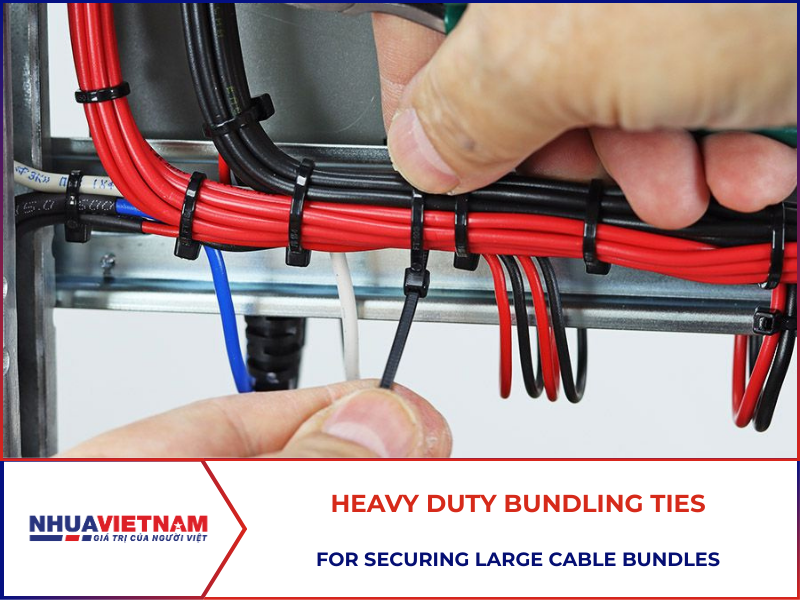
Why heavy duty bundling ties suit large cable bundles
Heavy duty bundling ties are engineered to address the mechanical demands of securing oversized cable bundles.
High tensile strength supporting heavy loads
Heavy duty bundling ties are manufactured with reinforced cross sections and locking mechanisms that provide higher tensile strength. This allows them to support heavy cable bundles without elongation or breakage. Their strength ensures consistent holding force even when bundles are subjected to dynamic loads.
Wide tie design improving load distribution
The wider design of heavy duty bundling ties increases surface contact with the cable bundle. This improves load distribution and reduces localized pressure points. Better load distribution helps protect cable insulation and maintains bundle shape over long service periods.
Common applications of heavy duty bundling ties for cable bundles
Due to their strength and reliability heavy duty bundling ties are widely used in demanding cable management applications.
Power and control cable management in industrial facilities
In factories, power plants and processing facilities heavy duty bundling ties secure large cable groups within trays racks and structural frames. They help maintain orderly routing while preventing sagging and excessive movement which simplifies inspection and maintenance.
Large scale infrastructure and utility installations
Infrastructure projects such as transportation networks, substations and utility corridors involve extensive cable routing over long distances. Heavy duty bundling ties provide stable fastening for oversized bundles ensuring alignment and load control across large installations.
Advantages of heavy duty bundling ties over standard cable ties
Selecting heavy duty bundling ties instead of standard options delivers clear operational benefits in high load applications.
Fewer fastening points and improved stability
Because heavy duty bundling ties can support greater loads fewer ties are required along the cable run. This reduces installation time and creates a cleaner layout while improving overall stability by minimizing weak points.
Reduced risk of slippage and bundle deformation
The enhanced grip and wider profile of heavy duty bundling ties reduce the likelihood of slippage. Bundles retain their shape and position which lowers the risk of deformation and long term damage to cables.
Selection considerations for heavy duty bundling ties
Proper selection is essential to maximize the performance and safety of heavy duty bundling ties.
Choosing correct length and tensile rating
The tie length must accommodate the bundle diameter while the tensile rating must exceed the combined weight and expected dynamic loads. Selecting ties with insufficient capacity can compromise system reliability.
Evaluating environmental resistance and material suitability
Environmental conditions such as heat UV exposure moisture or chemical contact influence material performance. Heavy duty bundling ties should be chosen with appropriate material properties to ensure long term durability in the specific operating environment.


